by Vaughan Gunson
The time has been right for many years to reimagine the future of farming in Aotearoa New Zealand. Even as the dominant industrial farming model continues to strengthen its hold on land, capital and politics. But the current concern over the supply and cost of diesel, sparked by Israel’s and America’s war on Iran, is raising questions in real time, not least for farmers themselves. “No diesel?” “How will we farm?” “How will our products get to market?” Indeed.
Whatever the outcome of the current crisis, the flow of petroleum products reaching the farthest destination on the energy highway is going to slow to a trickle eventually. Before one day ceasing altogether. We can argue the timeline, but it’s difficult to argue against the inevitability, resulting from the complex interplay of declining oil reserves, falling returns on energy invested, geopolitical standoffs and outright wars, worsening climate change, soon-to-be-bursting debt bubbles, ballooning freight costs, broken supply chains, increasing costs of maintaining infrastructure, and other global market breakdowns. More could probably be added, but you get the picture. The world we’re moving into is one where the cheap energy that industrial farming relies on, at all levels of the farming process and then beyond to the surrounding economy, will no longer be available. That will mean farming in New Zealand, like many other things, will be forced to change.
This blog will argue that future farming in this country will be smaller in scale and more localised in its inputs and outputs. That’s not an original claim. Many in the Green and organic farming movements have for years advocated small farming, with some, against the odds, attempting to be small farmers and growers. So I can only say I’m adding to a tradition, and then trying to keep the thinking fresh and relevant to a fast-changing contemporary world.
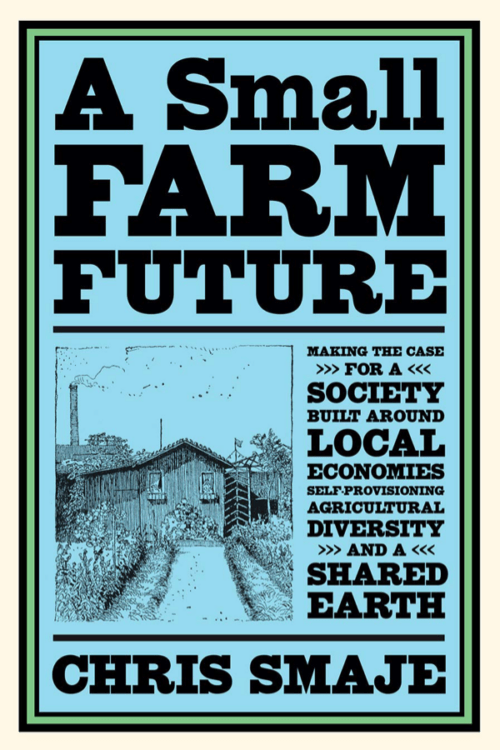
To help with the ongoing telling of this story, I plan to initially focus on a book titled A Small Farm Future (2020) by Chris Smaje. A Somerset small farmer and writer, and in a past life a social sciences academic. While I had broadly come to similar conclusions to Smaje before becoming a regular reader of his blog (prior to his writing his first book), it’s his clarity and rigour, his breadth of knowledge, his realism, his constant questioning, as well as the fact that he has skin in the game, that kept me reading. Hopefully I can interest others to read his books and the blog. That’s one goal.
The other is just to start writing with the thought that maybe I’ve got something to say (and learn) that’s relevant to us here in Aotearoa New Zealand. I want to bring a local flavour to the ideas Smaje and others are raising, which will require improving my knowledge of farming in this country, both past and present, while keeping an eye on government-level politics and institutional decisions that are making wrong assumptions even about the near future. Not that this is particularly surprising, as the power of vested interests, short-term thinking, group-thought paralysis, and resistance to change are major barriers to society moving in a direction that might require us to forgo some of the trappings of our modern lifestyles. That story has quite a hold on us.
As much as it’s impossible to know exactly how things are going to turn out in the future, based on a broad understanding of history, human nature and science (particularly around energy), we can with more confidence say that “this outcome” advocated by “this person” isn’t going to happen. (You could insert any of the many fanciful pronouncements of Elon Musk.) High-tech fantasies, divorced from energy realities, geopolitical realities, and human motivations for a “good life”, will certainly be a target of my sceptical, educated-as-much-as-possible disbelief. The relevance of advocating a small farm future, as I see it, is partly to prepare people for what’s not going to happen. Letting go of false beliefs might be painful, but building a foundation for new ones that are closer to how the world is and likely to be is a better place to start pursuing politics, imagining cultural change, or simply surviving in a difficult world without “losing your head.”
As for my personal background, most of the time I’m out there hustling in the capitalist economy to make a buck, some of which goes to support my kids through university, and with one eye on retirement. I earn and I consume, I gripe and groan, I have moments of fun and enjoyment, and start the week again. I say that to emphasise that I’m not claiming any great virtues or wishing to project any moral superiority to readers or anyone else. The last thing I would want to be, or be mistaken for, is an example for others to follow. I will assume that any reader has the capacity to be acting better in the world than myself. Mostly, I aim to present facts and arguments as I see them, and draw connections between different thinkers and areas of knowledge. I fully accept that we are all complex and contradictory individuals with multiple identities, and never one “essence”. A small farmer isn’t just a small farmer. Even Donald Trump isn’t one thing, though we might want to project the worst kind of “essence” onto him. All of us are caught in structures and systems that constrain us and influence the spectrum of our identities and behaviours.
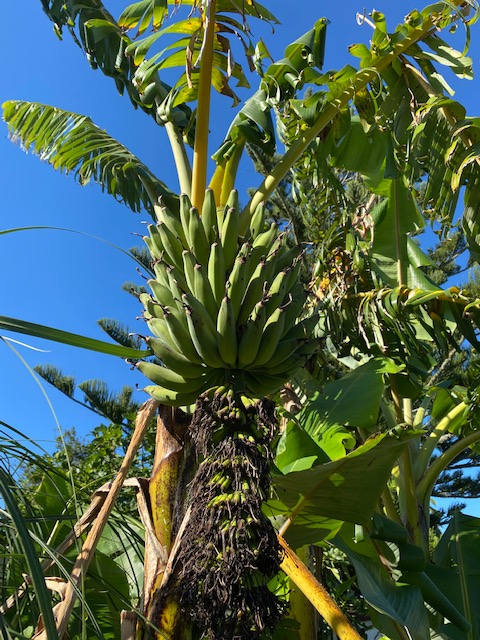
But to put a pause on things getting “too philosophical,” you might be wondering if I’ve ever put on gumboots and got my hands dirty. Well, I have some experience over the last twenty-five years of growing a small amount of food on our quarter-acre section in Hikurangi, north of Whangārei. The usual stuff in a vegetable garden. At times maintained with enthusiasm, and at other times, falling into a neglected mess of weeds. The rest of the section has been planted with numerous fruit and nut trees. Including olive trees (occasionally pressed and pickled); orange, lemon and mandarin trees (a family favourite); fig trees (a personal favourite, which someone in the family contends “taste like socks”); apple and pear trees (increasingly less successful as the winters have noticeably warmed); an apricot tree (sometimes successful); a plum and nectarine tree (not so much); blueberries and blackberries; almond trees (yet to produce a single almond); a macadamia tree (now prolific); and the biggest success story as the local climate has warmed, bananas. Convincing me that Northland will become the “banana republic” of New Zealand, in a good way. For ease of growing and eating, the banana has become my garden hero.
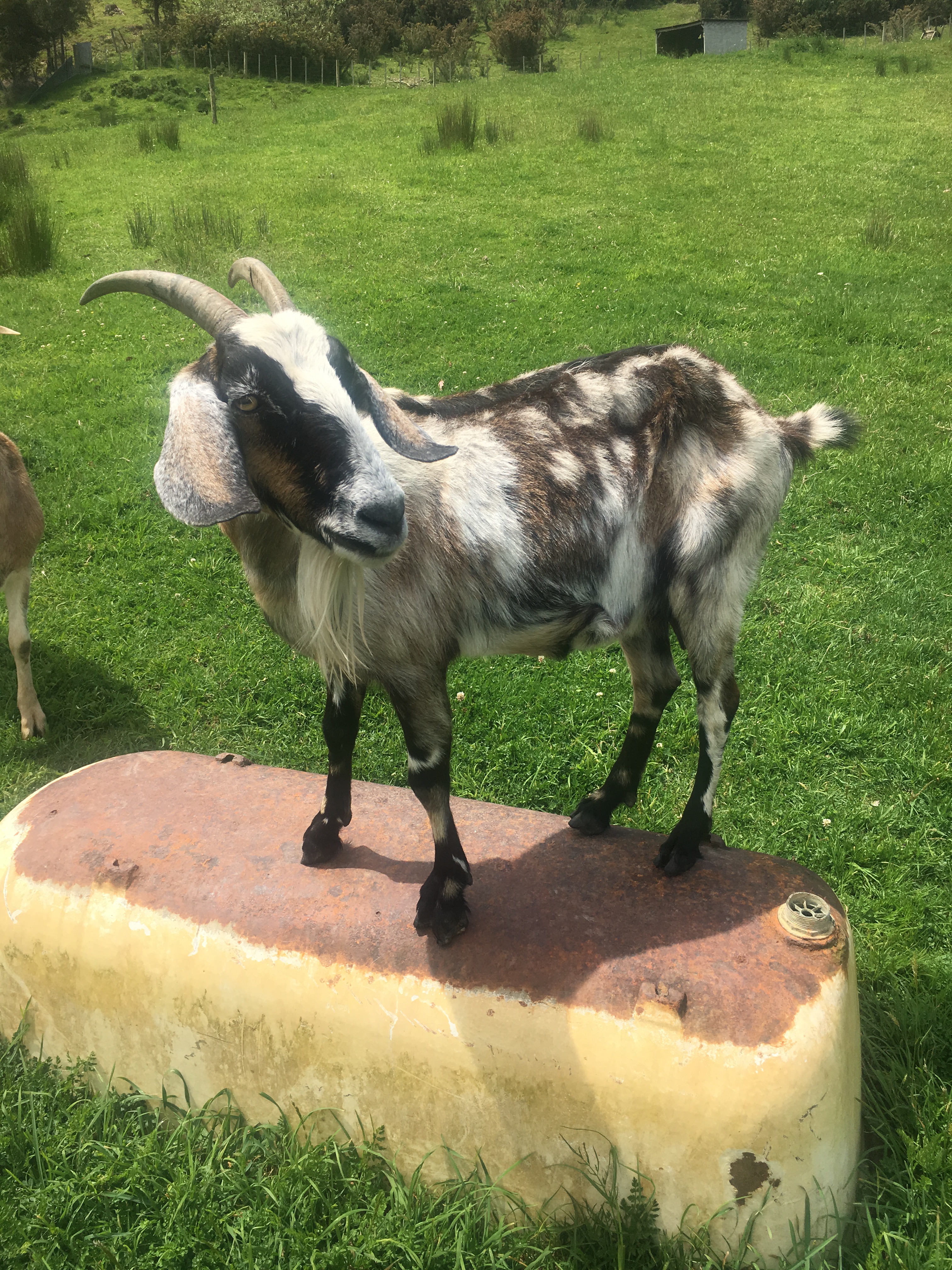
I have also maintained access (through a tiny lease) to land owned by a generous neighbour over our back fence, on the other side of a currently disused railway line. First, for a Shetland pony for the kids, then two female Nubian goats (sort of for the kids, too), who, with the addition of a short-lived billy and the birth of some cute-as-kids, were milked by hand morning and evening for 18 months. The problem of what to do with the kids (the goat ones), when you weren’t prepared to eat them, put pay to the idea of proper goat farming. I’ve also experimented with heritage-breed chickens and ducks, both for eggs and meat. Cleaving animal fowl for dinner, I can manage, though I’ll agonise about it for days prior.
Then there’s all the fruit and nut trees I planted on a goat-proofed portion of the leased land in a COVID lockdown-inspired burst of energy and enthusiasm, together with a fenced 50-metre-square vegetable garden, brought into being with much hard labour and a truckload of topsoil. The vegetable garden has since become somewhat neglected as the pressure to earn money to support the kids (the human ones) through university has become a little more acute (and because we’re probably just too damned attached to a middle-class lifestyle to go all peasant-farmer yet). Nevertheless, this aspirational garden initiative, pursued during lockdown, has sometimes provided us with kumara, sweet corn, pumpkin, potatoes, tomatoes, zucchini and cucumbers. The fruit and nut trees, on the other hand, planted mostly on sloping, wind-exposed land with poor clay soil, were a failure. I now at least have a working knowledge of what they mean by marginal land.
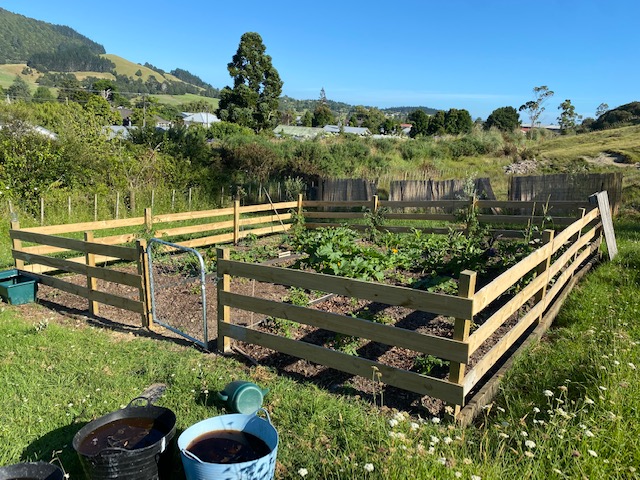
Through all this, I’ve learnt (surprise, surprise) that growing food is hard work, harvesting and preparing the food you’ve grown takes time (except those amazing bananas!). And if you’re away from home five or six days a week, earning that thing we call money, then it doesn’t really work. For now, the half hectare of land that I have some responsibility for is at least largely free of gorse thanks to spade, spray and goats. There’s a small shed that collects rainwater, some usable fencing, and a few fig and macadamia trees hanging on. The big vegetable garden, however, is in limbo. But I have hopes to do better this Spring. There’s also a small flock of sheep that are, strictly speaking, owned by my neighbour, but which mostly graze the land I’ve been leasing. In return, I get to decide when the local homekill guy turns up to fill our freezer.
If I were to identify success from this growing and farming-adjacent activity, which points to the future of this small parcel of land, it would be the bananas, macadamia trees, and sheep. This exposed hillside, with its shallow topsoil, is best suited for converting grass into animal protein. So there have been some learnings, but if you want advice and tips on small-scale farming, this blog won’t be where you’ll find them. Only perhaps in the most general sense, and then I’ll be borrowing ideas from other people more knowledgeable than I.
What I do hope to bring to this blog is years of following politics in this country (for some years as a columnist for the Northern Advocate) and, in my younger adult days, a writer and activist of sorts in the socialist tradition. Following a crisis of belief, I’ve done a lot of reading. I’ve roamed human biological sciences, evolutionary theory, complexity theory, economics and political economy, theories of the state and their collapse, and more. So many good writers whose ideas I’ve largely forgotten. But somehow I feel it’s all still with me, like an aged and complex red wine. My understanding of the world feels deeper than it was, though I’m far less certain about anything. However, I can’t keep just reading forever without being a little systematic in working out what I actually think, and how it might apply to today’s and tomorrow’s world.
To sum up, this blog isn’t going to be about how to be a small farmer, but more about why some of us should, and why political and cultural space needs to be opened up for people who want to be small farmers. Large-scale industrial farming in pursuit of global profits, which requires high fossil fuel inputs (either pumped directly into machinery or used to manufacture fertiliser), isn’t going to last. Therefore, we’ll need a different way of organising the landscape and distributing people through it. So we can eat, of course, but also live meaningful lives with respect for the natural world and each other. I have a concern that any new reorganisation of land and society is fair and at least somewhat egalitarian. What kind of politics and governance might support such a future? Where does the worldview of Tikanga Māori and the Treaty of Waitangi fit? And what of the land claims of different iwi and hapu? What role does the New Zealand state have in all this? What opportunities and what dangers flow from the certain collapse of global capitalism in the years ahead?
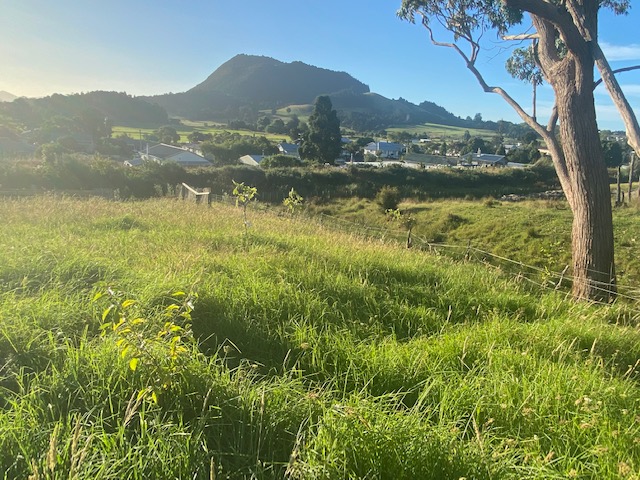
I don’t have easy answers to those questions and many more, but I can’t see how our current levels of urban complexity, global interconnectedness and hyper-specialisation, all built on a one-time energy bonanza, can survive. The future will be more rural, with much shorter supply lines, like it or not. Preparing ourselves to like it, or at least accept it, and thus better meet the challenges, seems a sensible option.
 Site Title
Leave a comment